
India's Aerospace Supply Chain Play
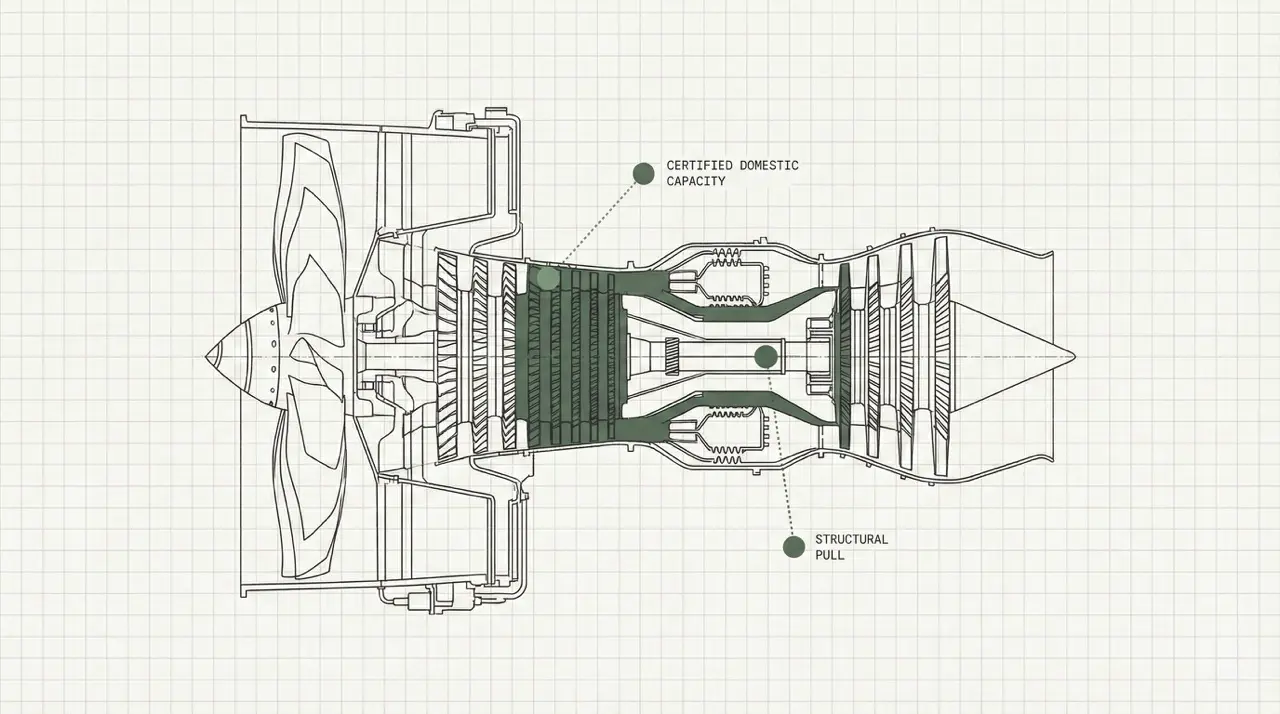
India's aerospace supply chain is shaping up to be one of the more compelling structural themes in Indian manufacturing today. Not because of any single policy announcement or order win, but because a set of conditions are converging—order books, OEM diversification needs, certified domestic capacity, and budget-backed policy direction—that together create a meaningful opportunity window.
This is not a prediction. It is a framework for tracking execution against that window.
The Setup: Order Books and the Manufacturing Pull
Indian carriers currently hold over 1,600 aircraft on order—roughly 9 to 10 percent of the global commercial backlog. IndiGo alone sits on approximately 950 aircraft orders, the largest single-airline commercial order book in history. Air India, post-consolidation under the Tata Group, holds another 500-plus across both Boeing and Airbus. These are not speculative orders. Delivery windows are staggered through the next decade, and deposits have been placed.
The scale here is worth pausing on. India's operational fleet stands at approximately 800 aircraft today. The order book effectively doubles the fleet over the next seven to eight years. That volume of inductions creates structural pull across the supply chain—engines, aerostructures, avionics, landing gear, interiors. Someone has to make these parts.
Why India, and Why Now
Boeing currently sources over $1 billion worth of components from 325 Indian suppliers. Airbus has crossed €1 billion in Indian procurement and has publicly committed to doubling that figure. These are not aspirational numbers—they represent existing contracts with certified vendors.
Budget 2026 reinforced the policy direction. The defence allocation rose 15.19 percent to ₹7.85 lakh crore, with aircraft and aero engines specifically receiving ₹63,734 crore—up from ₹48,614 crore the prior year. Customs duty exemptions were introduced on components and raw materials for both civilian aircraft manufacturing and MRO activities. The signal is clear: the government intends to build a domestic ecosystem, not simply operate imported assets.
More importantly, Airbus has now entered what it calls "Phase Three" of its India strategy—transitioning from component sourcing to full aircraft assembly. The first Made-in-India C-295 military transport aircraft is expected to roll out from the Tata–Airbus facility in Vadodara by September 2026. A helicopter assembly line for the H125 is operational in Karnataka, with first deliveries planned for early 2027. These are not MoUs. These are factories.
The India–US trade agreement, now signed with effective tariffs settled at 18 percent, provides additional structural comfort. Relative to other geographies, Indian manufacturers retain a competitive edge on cost and increasingly on capability. The EU trade negotiations advancing and deepening bilateral ties with France and the UAE add further visibility for export-oriented aerospace businesses.
Certified Suppliers: The Moat in Aerospace
In aerospace, certification is the moat. AS9100, NADCAP, OEM-specific qualifications—these take years to obtain and significant capital to maintain. Once a supplier is certified, switching costs for OEMs are high. This is structural, not cyclical.
Indian suppliers who have crossed this threshold are well positioned. Dynamatic Technologies supplies flap-track beam assemblies for the Airbus A320 and A330 families and has been selected for all major door structures on the A220 programme. Tata Advanced Systems manufactures composite assemblies for the Boeing 737 MAX, 777X, and 787 Dreamliner—and is now the partner of choice for the C-295 final assembly line. HAL, MTAR Technologies, Aequs, Bharat Forge—each has carved a defined niche within the global supply chain.
The question is not whether certified capacity exists. It does. The question is whether that capacity can scale to meet the delivery windows OEMs have committed to—Airbus targeting 1,044 deliveries in 2026 and 1,188 in 2027, Boeing targeting 708 and 870 respectively. The production ramp is aggressive. Supply chains that can deliver on time will be rewarded disproportionately.
Key Variables Worth Tracking
The thesis rests on a few critical variables.
- OEM appetite for vendor diversification. Post-pandemic supply chain disruptions—and the ongoing fallout from quality and production issues at key Western suppliers—have made diversification a strategic priority, not a cost exercise. India is a beneficiary, but execution must be demonstrated at scale.
- Capex cycles of Indian suppliers. Success must align with aircraft delivery windows. A supplier investing in capacity today needs to be producing at scale within 18 to 24 months. Delays compress margins; early investment without confirmed orders burns cash. The timing is tight but navigable for well-capitalised players.
- Certification completion rates. The pipeline of Indian companies seeking NADCAP and OEM-specific certifications is growing, which is encouraging. Not all will succeed. The conversion rate from application to active qualification determines how much of the addressable market Indian suppliers can actually capture.
- Policy consistency. The indigenisation mandates, PLI incentives, customs duty exemptions, and MRO policy reforms all point in the right direction. But aerospace supply chains require decade-long planning horizons. Policy reversals—or even prolonged ambiguity—can stall investment decisions. Continuity matters more than generosity here.
Risk Factors
I want to be direct about the risks.
- Airline order cancellations in a downturn remain a real possibility. The 2008 cycle and the post-COVID period both saw deferrals and cancellations that rippled through the supply chain. If global air traffic growth slows meaningfully or if Indian carriers face financial stress, the backlog may not fully convert to deliveries.
- Quality failure is an existential risk for individual suppliers. A single NADCAP audit failure or OEM blacklisting can eliminate years of investment and pipeline. The margin for error in aerospace precision manufacturing is essentially zero.
- Final assembly line decisions are pivotal. The C-295 programme in Vadodara will determine tier-1 contract flow for years. If execution is clean, it establishes a template for future programmes. If it stumbles, it delays the broader ecosystem build-out and weakens India's case for the next round of OEM sourcing decisions.
- Labour availability at aerospace precision standards is a genuine constraint. India has manufacturing scale, but aerospace-grade quality control requires specialised training and process discipline. The talent pipeline is developing but not yet mature.
Framework, Not Forecast
This is a thematic overlay—a set of structural conditions that, if execution meets timelines, creates a multi-year runway for select Indian aerospace manufacturers. The order books are real. The policy direction is clear. Certified capacity exists.
What remains to be demonstrated is execution at scale. The things to watch: quarterly certifications, OEM sourcing announcements, capex commitments, delivery milestones. The opportunity window is open. Whether Indian industry walks through it will depend on execution, not intent.